 The Water Theft Cartel
ESPEN
The Water Theft Cartel
Fuel came first: the U.S. Treasury already learned the anatomy of smuggling. Water is the same crime with a different liquid: illegal extraction, coerced sales, governors hoarding, and a counter that charges for the meeting. 716,497 concessions, 322 seized trucks, and a complaint already filed with the DOJ. This is the full network.
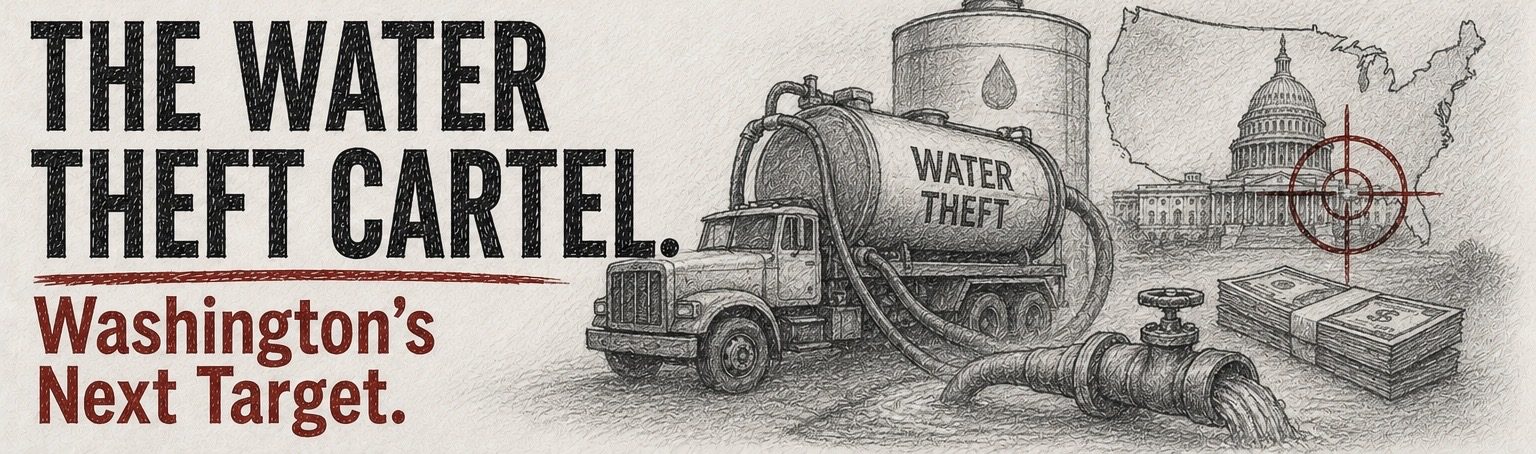
This investigation tells a simple story: in Mexico, the nation's water became a private business. One single office — CONAGUA — decides who gets water and who doesn't. Around that decision grew a network: politicians holding concessions in their own names, shell companies with multimillion contracts, middlemen reselling free water at 13 pesos per cubic meter, and trucks stealing what the tap never delivers. Whoever controls the door charges to open it.
For decades, the United States prosecuted Mexico for one thing only: the narco. Kingpins, cartels, extraditions. That has changed. The same tools sharpened against drug trafficking — money laundering, the criminal-enterprise pattern, the Treasury lists — are now aimed at political corruption. And in 2023 the missing piece arrived: a law that directly punishes the foreign official who demands a bribe.
Why can a court in Washington judge Mexican corruption? Because of one simple rule: if the money, the company or the victim touches the United States, the United States has a judge. The crime doesn't need to happen there. One dollar, one account or one American investor at the table is enough. Try the two buttons and the three cards:
Who holds the water, how charging for the meeting became a system, and the new legal route against the official who demands.
Water concentrates. The decision over who receives it concentrates even more. Where the decision concentrates, the rent is born.
The registry reports 272.3 billion cubic meters across 716,497 permits. On paper, the resource is not missing. What's missing is the door: who decides whose tap opens, whose permit renews, whose use gets changed. When a single counter controls access, access becomes merchandise. What's for sale isn't the water. It's the meeting.
It isn't one corrupt official. It's a five-piece architecture turning every authorization into a cash register. Walk through it.
Thus the charge stops being an act and becomes an sistema operativo. The same pattern running in water runs in defense, tourism, military contracts and any counter where the State controls the yes. Water is just the sector where it can finally be measured.
Cinco casos con fuente. Toca cada tarjeta para abrir el expediente.
Illegal extraction. Coerced sales. Markups. Groups tied to crime. Fuel smuggling is already on the U.S. Treasury's radar; water smuggling has the same anatomy.
In October 2025, Operation Caudal struck water smuggling across 48 municipalities of the State of Mexico. What it found was not improvisation: it was an industry.
Illegal wells, taps milking the public network, and a captive market where consumers were forced to buy only from trucks affiliated with organizations like Los 300, La Chokiza, USON, ACME, Libertad, 25 de Marzo and 22 de Octubre, flagged by prosecutors with alleged ties to organized crime. The markup in Ecatepec: 59%. The network's answer was to blockade the Valley of Mexico.
The chain doesn't end in the street. Trucks painted in official CONAGUA livery — and federal and state liveries — were seized selling water to private businesses. In Puebla, a tap wired straight into the utility's main line extracted 3.5 million liters a day. Smuggling doesn't compete with the system: it lives inside it.
Fuel came first. Washington already learned the anatomy. Water is the same case file with a different liquid.
The same arbitrage runs with papers in order. Tijuana is entitled to 80 million m³ a year under the 1944 Water Treaty, but consumes about 190. Every October 1st its own water runs out. Then it has to buy.
The seller is Irrigation District 014 in the Mexicali Valley: water licensed as agricultural — free by law — that its "water bank" auctions for urban and industrial use at 13 pesos per cubic meter. A witness from the valley describes it: "a computer and 3 individuals, nobody audits". It invoices about 80 million m³ a year to Tijuana alone, takes a 7% commission, also sells to companies and developers, and pays producers "at whim". The state government signs the deal and bills citizens for the water.
The president herself put the invoice on the table: 531 million pesos paid by the municipalities over five years, a profit that — she said — stayed "in the hands of a few people", derived from a national resource. What the briefing didn't answer is what this investigation asks: who are those people? Who authorized every transfer over 24 years? The counter that signed them all has a name: CONAGUA. And the only district in the country that refused to sign the National Water Plan is, precisely, the one running the business.
The water the nation gives away as agricultural is resold to the city at 13 pesos per meter. The invoice is public now. The names are not — yet.
Drag the nodes. Tap any to open its sourced file. Filter by layer: officials, politicians, corporates, mechanisms and U.S. justice.
Each state shaded by what it hoards. Each red dot: a politically exposed person holding a concession in their own name.
Fifty-four georeferenced points: the plan's 17 projects, the documented irregularities, the smuggling and the hoarders bearing governors' names. Filter by layer and tap any point.
Twenty-two politically profiled holders in the Mexican State's registry — PAN, PRI and Morena. One former president, two SITTING governors, FOUR sitting senators, four former governors and three full dynasties. Sort the table by any column.
The database of 716,497 REPDA permits behind this chapter, the map and the atlas was first opened, cleaned and visualized by the investigation "¿Quién tiene el agua?" by TIRANDO CÓDIGO. Without that open-data work, the names in this table would still be buried in an unreadable registry. This investigation crosses that base with coordinates, press, the federal audit, MCCI and the filed complaint. The original credit is theirs.
Pick a name from the table and translate their annual volume to human scale.
Whoever signed water decrees yesterday shows up today as their concession holder. That is the hydraulic revolving door.
From Heineken to La Norteñita: a handful of corporates hoard volumes equal to entire towns' consumption while urban networks ration.
The authority itself admits it: incompatible databases, registries that don't add up, files stalled for years. It sounds like incompetence. It works like design.
Un sistema que no se puede auditar es un sistema donde el criterio sustituye a la regla. Y donde manda el criterio, manda quien firma. El rezago confesado no es la falla del sistema: es el inventario que da valor a la cita.
From the helicopter to the loyalist without water: five chiefs, one agency, the same outcome for whoever runs the counter.
The federal audit documented the money. MCCI documented the network. Operation Caudal documented the street. And the DOJ complaint documented the method. The term changes; the tap is the same.
For decades, U.S. law punished whoever pagaba el soborno (FCPA). El funcionario que lo exigía quedaba fuera de alcance.
La Foreign Extortion Prevention Act (FEPA) cierra ese hueco: ahora EE.UU. puede perseguir penalmente al funcionario extranjero que solicita o acepta un soborno. La cita con precio deja de ser intocable.
To this day there is no first FEPA defendant. That is not weakness: it is the preliminary phase. The DOJ already charged intermediaries for bribing CFE officials, and its first FCPA indictment after the pause targeted two Mexican nationals. The declared priority: Latin America. And the law mandates an annual public report of bribe demands by foreign officials: a registry where the names land.
The threshold is no longer who pays. It is who asks.
How does a counter in Mexico connect to a court in the United States? Through the money around it.
An infrastructure fund with U.S. capital, accounts or counterparties works as a lens: it brings local activity within reach of U.S. law. The crime needn't be exported. It is enough for the flow to touch, at some point, the American financial system.
Thus the meeting fee — invisible to Mexican auditing — becomes visible, and prosecutable, from outside.
And this is no longer hypothesis. Under the current director, the water portfolio with foreign money or a U.S. nexus sits open on the same counter. The complaint filed with the DOJ alleges that on infrastructure projects money was demanded for the meeting. This list is the universe where that allegation becomes jurisdictional: every project with a dollar inside is a potential FEPA case.
The border's biggest water project this term, tendered directly by CONAGUA. The first call (Nov 2025) was declared void and relaunched "with some changes". Today 7 consortia with 30 national and foreign companies compete, economic bids submitted and the award pending at the counter. The project's record was already binational: the 2016 contract went to SUEZ and a subsidiary of NASDAQ-listed Consolidated Water, with San Diego's Otay Water District filing before the State Department for a cross-border aqueduct to buy the water. Where foreign-parent bidders wait for a yes, FEPA is watching.
The Tijuana River cleanup is a binational commitment signed before the United States, with EPA money in the scheme. The Mexican piece includes the San Antonio de los Buenos treatment plant, where the federal audit already documented 64.5M MXN in damages: asphalt paid for and never laid. Works pledged to Washington, managed at the Mexican counter, flagged by the audit itself: the jurisdiction doesn't even need building.
The National Agreement for the Human Right to Water committed companies and industries — several multinationals with foreign parents or shareholders — to return over 2.5 billion m³ with private investment above 16 billion MXN. Every peso of that pledge is negotiated, certified and released at the same single counter. The foreign issuer negotiating there is, by definition, protected under FEPA: if anyone demands from it, the crime is already federal in the U.S.
The National Water Plan's "historic investment" axis: 17 strategic projects worth 122.6 billion MXN (2025–2030) — dams, aqueducts and irrigation districts. It is the same territory where MCCI documented the Ferroclin network, and the same program the senate water-committee chairman pushed in his meetings with the director. International equipment, technology and contractors compete for that portfolio. The complaint holds that there, sitting down costs a million.
The foreign-money portfolio is open. The counter is one. And the complaint is already where that money has a judge.
Filed with the U.S. Department of Justice. The complaint alleges a charge of one million pesos to receive infrastructure businessmen, and describes a network that, per the filing, includes public servants and sitting senators. The documentation goes to the case file, not to this page: that is how the chain of evidence is protected.
Washington doesn't hunt parties: it hunts jurisdiction. But Mexico's water counter today wears a single color, and four forces are converging on it at once.
In 2025, Mexico's Rio Grande water debt to Texas drew presidential tariff threats and forced emergency deliveries. Border water stopped being a technical binational file: it is direct political pressure. And this site's case files — the DR-014 water bank, the 531 million, the Tijuana arbitrage — live exactly on Treaty water.
In June 2025, FinCEN designated three Mexican financial institutions for laundering, and stolen fuel entered the sanctions radar in full. The method is proven: follow the contraband's money into the financial system and cut it there. Water smuggling has the same financial anatomy — with an aggravating factor: its rents touch works carrying U.S. federal dollars.
Chips, EVs, data centers: supply-chain relocation to Mexico depends on reliable water. When access is assigned by paid meeting instead of right, every U.S. investor in northern Mexico is exposed to extortion — and FEPA exists precisely to protect them. Protecting their supply chain means protecting their water.
The first FCPA indictment after the pause targeted two Mexicans; the DOJ's declared priority is Latin America; FEPA awaits its exemplary first case; and the Attorney General's annual report is the public scoreboard where the names will land. The question was never whether Washington could. It is who goes first.
Tap each station: this is how a peso demanded at the counter travels to a courtroom in Washington.
And why the ruling party's politicians? Not for their color: for their position. Whoever controls the counter controls the rent, and today the counter belongs to Morena: the director, the Senate committee that oversees him, the sitting hoarder governors and the senators in the registry. This investigation documents three parties in the table; but the meeting fee is charged from present power, not past power. When Washington builds the water case — and the four forces say it will — the names in the registry are the names on this page.
The narco taught Washington to prosecute Mexicans. Fuel smuggling taught it to prosecute rents. Water joins both lessons — and the counter has an owner.
Never has the yes been worth so much in Mexico: the new law concentrates every concession at a single counter. And never has demanding it carried so much risk: FEPA (2023) and the filed complaint (2026). The two curves cross.